سرفصل های درس یادگیری ماشین (لاتین)
چهارشنبه, ۱۱ دی ۱۴۰۴، ۰۶:۵۵ ب.ظ
1. Introduction to Machine Learning
- Definition and history of Machine Learning
- Machine Learning vs. AI vs. Data Mining
- Applications of ML in industry and research
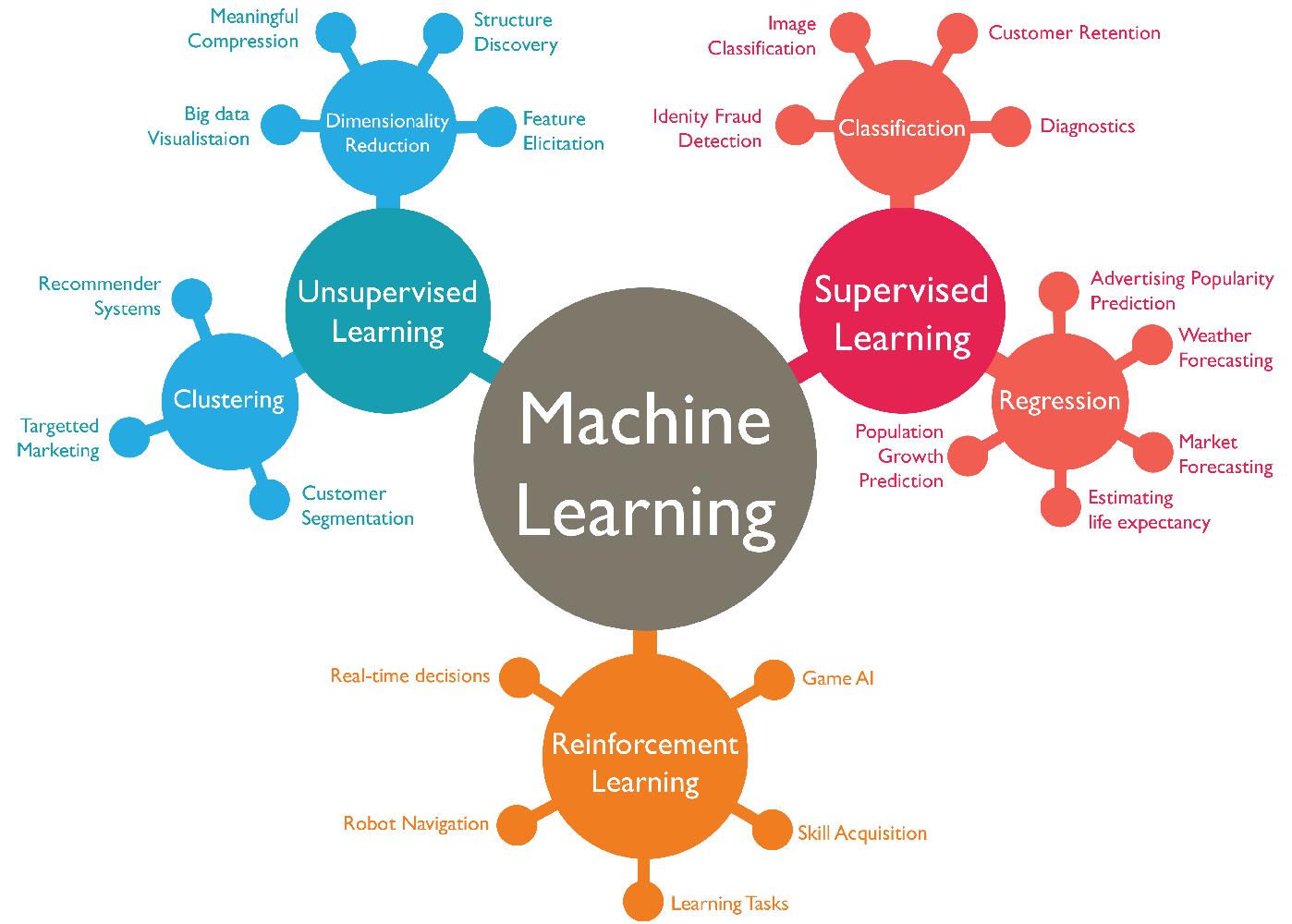
- Types of learning: supervised, unsupervised, semi-supervised, reinforcement learning
- ML pipeline and workflow
2. Python Tools for Machine Learning
- Python basics for data science
- NumPy, Pandas, Matplotlib, Scikit-Learn
- Data loading, preprocessing, visualization
- Working with Jupyter Notebook
3. Data Preprocessing
- Data cleaning: handling missing values, outliers
- Feature engineering and feature selection
- Normalization and standardization
- Train-test split, cross-validation
- Imbalanced data handling (SMOTE, class weights)
4. Supervised Learning – Classification
- k-Nearest Neighbors
- Decision Trees and Random Forests
- Logistic Regression
- Naïve Bayes
- Support Vector Machines (SVM)
- Performance metrics: accuracy, precision, recall, F1, ROC-AUC
5. Supervised Learning – Regression
- Linear Regression
- Polynomial Regression
- Ridge, Lasso, Elastic Net
- Decision Tree Regression
- Evaluation metrics: MSE, RMSE, MAE, R²
6. Unsupervised Learning
- Clustering: K-Means, Hierarchical clustering, DBSCAN
- Dimensionality reduction: PCA, t-SNE, UMAP
- Association rule mining (Apriori, FP-growth)
- Applications in anomaly detection and customer segmentation
7. Ensemble Learning
- Bagging, Boosting, Stacking
- Random Forest
- AdaBoost, Gradient Boosting, XGBoost
- Advantages and real-world use cases
8. Neural Networks and Deep Learning (Intro)
- Perceptron and Multilayer Perceptron (MLP)
- Activation functions
- Backpropagation
- Introduction to TensorFlow / PyTorch
- Comparison of traditional ML vs. deep learning
9. Model Optimization
- Hyperparameter tuning (Grid Search, Random Search, Bayesian Optimization)
- Feature importance
- Regularization
- Avoiding overfitting/underfitting
- Cross-validation strategies
10. Reinforcement Learning (Intro)
- Agent–Environment interaction
- Reward systems and Markov Decision Processes (MDP)
- Q-learning (basics)
- Applications in robotics, games, optimization
11. Real-World ML Project Development
- Defining the problem
- Data collection and labeling
- Model selection and evaluation
- Deployment: API, cloud, edge computing
- Ethical considerations in ML (bias, privacy, fairness)
12. Case Studies
- ML in healthcare
- ML in finance
- ML in aviation (you may introduce BIM-LSTM here)
- ML in social media and marketing
13. Final Project (Optional)
Students design and implement a complete ML model
- Dataset selection
- Preprocessing
- Training, evaluation
- Presentation
